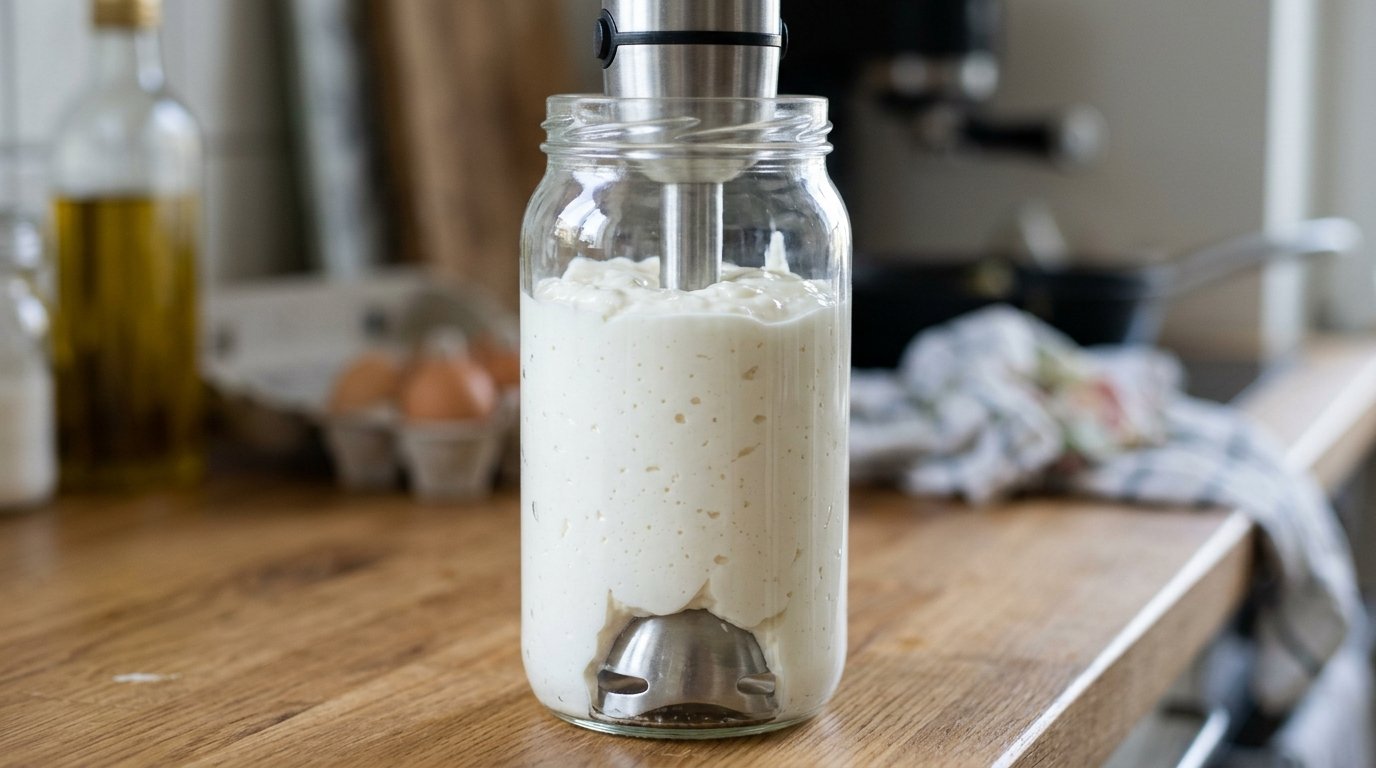
Looking to make some mayo with an immersion blender? Most of us start off with a whisk, bowl and sore arm, and add the oil too quickly, therefore ended up with a bowl of oily soup. The immersion blender solves this issue almost entirely. All you need is a tall jar and a few ingredients from your pantry, and a little trick.
This guide will show you exactly what you need to put in your jar, the best tools to use. Plus we’ll show you how to blend it all together, and how to fix any issues if your mayonnaise isn’t thickening. Find out what oils are best to use, how to keep your eggs safe and how long your mayo will last in the fridge. By the end you’ll have a smooth mayonnaise made in less time than it took you to find your whisk!
Ingredients and Equipment for Mayonnaise with an Immersion Blender

Mayonnaise only requires a few ingredients. Most you will have in your kitchen already. Take a large egg, about a cup of neutral oil, plus a tablespoon of lemon juice or white vinegar. Add 1/2tsp salt and a bit of Dijon mustard (this isn’t essential but will help to add flavour and ensure the mayonnaise holds). I would suggest using a mild oil such as avocado oil, sunflower oil or light olive oil.
You will need an immersion hand blender and a tall jar that can fit the attachment tightly. Using a wide mouthed mason jar (pint size) will work well with many blenders and also the beaker that comes with your blender. This ensures that the blades are going to get into your oil well. If your jar is too wide then your ingredients won’t mix well.
How to Make Mayonnaise with an Immersion Blender
Making mayonnaise using an immersion blender is a simple two step process. Firstly the blades are inserted and whips up the egg and a little oil to make a thick mixture. When lifting the blender out the rest of the oil will mix in. Sounds too easy? It depends on the order the ingredients are added in.
Layer Everything in a Tall, Narrow Jar
Crack the egg into the jar, then add the lemon juice, salt and mustard. Add the oil and leave it to settle for about 15 seconds. The egg will sink to the bottom of the jar. Lower the blender over the jar so that the blending head is flat against the bottom of the jar. This will cover the egg. Do not turn the blender on yet.
Blend Your Immersion Blender Mayonnaise, Then Lift Slowly

Blend on high speed. Ensure that the lid sits flat against the bottom of your jar. After 10-20 seconds, you should begin to see thick white mayonnaise starting to form underneath the blades. Slowly lift the lid to make sure to get the remaining oil incorporated into your mayonnaise. Stop blending once the mayonnaise is thick and creamy, this should take just over a minute.
How to Fix Broken Immersion Blender Mayonnaise

Don’t bin your runny mayonnaise. This is normally due to adding the blades too quickly, a large jar or cold ingredients. In all cases the egg couldn’t bind with the oil to create a stable base. But you can normally fix it in under a minute!
Take another clean jar. Add a fresh egg yolk. Whizz up the yolk for a second. Then add your broken mayonnaise a few spoons at a time. Once it starts to thicken you can speed things up. This fresh yolk will give your oil something to bind to. If you had a large jar use a smaller jar to save you any issues.
Tips for Thicker, Creamier Immersion Blender Mayonnaise
Once you know how to make mayonnaise in an immersion blender there are a couple of tips that will make your mayonnaise even better. The 2 most important things to know are the type of oil used and the type of egg. Once you get these right you should not see any emulsification issues or bitterness in your mayonnaise. Both can be done easily with a little preparation.
Oil
Egg
Pick the Right Oil
The most neutral oils will give you the cleanest tasting oil. Avocado, sunflower, canola or light olive oils all work well. However extra virgin olive oil can be an issue as it can become quite bitter because of the emulsification. If you really like olive oil try replacing around 1/4 of the oil with extra virgin olive oil and still have the rest as a neutral oil.
Egg Safety and Room-Temperature Eggs
Cold eggs can be more difficult to start forming an emulsion, so leave your eggs to get warm for a while. As this mayonnaise contains raw egg, we recommend using pasteurised eggs. This is especially important if you are cooking for children, elderly people, pregnant women or those with a weak immune system. Whichever type of egg you use choose fresh and intact eggs and store the mayonnaise in the fridge.
How to Store Homemade Mayonnaise

Now you know how to make Mayonnaise using an immersion blender, it’s time to store it correctly. As there are no preservatives in homemade mayonnaise, it will not last as long as the store bought version. Once you have made your mayo, store it in the fridge in a clean airtight jar/ container. Place it at the back of the fridge where it will be a consistent temperature. It should be used within approximately 4 days.
Label your jar with the date. If it smells, looks different or has been left out for longer than 2 hours, throw it away. Don’t freeze it, as it will cause the emulsion to split and the texture will not return. The smaller the amount you make the fresher it will be. This recipe will make a fresh batch in approximately 1 minute.
FAQs About Making Mayonnaise with an Immersion Blender
Is it hard to learn how to make mayonnaise with immersion blender?
No, most people make a nice thick mayonnaise first time. Fill your tall jar with some oil, add a layer of egg and whizz on a low speed to form your mayonnaise. This will only take around 1 minute. All you have to clean up are the jar and blender head.
Why isn’t my immersion blender mayonnaise thickening?
It’s usually due to the jar being too large, too low a temperature or lifting the blender too early. Allow it to start forming an emulsion on the bottom. It should rise slowly. If it’s still runny, add freshly blended egg yolk from a clean jar and add your ‘failed’ mixture a teaspoon at a time.
Can I use a whole egg instead of just the yolk?
Yes, using the whole egg will give you a lighter fluffier mayonnaise. Using just the yolks gives you a much richer and a little denser mayonnaise. Either way I’d go for roughly one cup of neutral oil per egg. Using the whole egg makes it easier for beginners as the whites help the mix come together quickly.
What’s the best oil for homemade mayonnaise?
Avocado oil, sunflower oil, canola oil and light olive oil will give you a clean flavour with a creamy consistency. Extra virgin olive oil can become quite bitter once mixed so only use a little. If you want an olive flavour, you can replace around 1/4 of the oil with extra virgin.
How long does homemade mayonnaise last in the fridge?
You will want to use this within 4 days. Place inside a clean jar with a secure lid and keep towards the back of your fridge to help keep the temperature more consistent. As there are no preservatives in homemade mayonnaise, label with the date you made it. If it smells or looks off, discard.
Is it safe to eat mayonnaise made with raw egg?
There is a slight risk of salmonella in raw eggs. The best option would be pasteurised eggs as they pose less of a risk. If you can’t get pasteurised eggs then use fresh eggs with no cracks and keep your mayonnaise in the fridge. Discard after 2 hours.
Final Thoughts on How to Make Mayonnaise with an Immersion Blender
You now know how to make mayonnaise using an immersion blender. It only takes around a minute to make. Using a tall jar, layering your ingredients and lifting slowly will do most of the job. If anything goes wrong then adding a fresh yolk will save your batch. Store in the fridge and use within 4 days. Always use pasteurised eggs if you are making this for someone vulnerable. Grab an egg and jar and make your first batch tonight. Tell us how you got on in the comments below or share this guide with a friend who still buys ready made mayo.